

Classification
Morning sickness or more?
Nausea during pregnancy is often referred to as morning sickness. However, this term is misleading, as many women experience discomfort and nausea throughout the day. The duration and severity of the symptoms vary from woman to woman. They range from a queasy feeling in the stomach in the morning to severe nausea and frequent vomiting several times a day.
Many women are sensitive to certain stimuli during pregnancy. These stimuli, which can increase nausea, include:
- Smells
- Heat and humidity
- Noise
- Visual stimuli (e.g., flickering lights)
- Rapid changes in position or sudden movements (e.g., driving)
In up to 95% of those affected, the symptoms persist well beyond the morning.
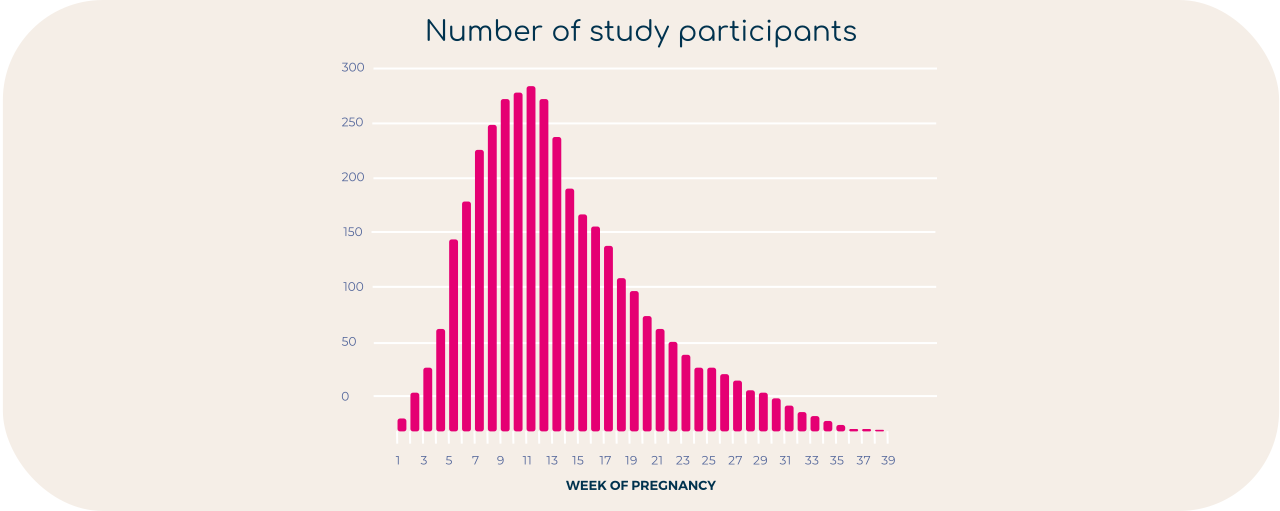
- They usually peak around the 10th week of pregnancy.
- In general, nausea and vomiting during pregnancy last for 6 to 8 weeks. In 90% of women, the symptoms disappear in weeks 14 to 16 of pregnancy.
- However, in 10% of women, the symptoms persist throughout the entire pregnancy.
Distribution of morning sickness by week of pregnancy
NVP: Nausea and Vomiting of Pregnancy according to Vellacott et al, 1988, Int Fed Gyn&Ob 27:57-62
Emesis vs. Hyperemesis gravidarum
The difference between emesis (Greek for vomiting; usually referring to nausea and vomiting) and hyperemesis (severe vomiting) gravidarum lies in the severity and consequences: Emesis is harmless vomiting during pregnancy, while hyperemesis is a severe, pathological form with persistent vomiting that leads to weight loss, dehydration, and metabolic disorders and requires medical treatment. This decision should definitely be made by a doctor.
Emesis
Emesis gravidarum, morning sickness
Frequent nausea and increased vomiting during (early) pregnancy, often occurring in the morning or at certain times of the day. It is unpleasant and can significantly restrict the pregnant woman in her everyday life, but does not lead to weight loss or dehydration.
Hyperemesis
Hyperemesis gravidarum is a severe, persistent form of pregnancy associated sickness that requires medical intervention.
It manifests itself through frequent vomiting (more than 5 times a day), significant weight loss (more than 5% of the initial weight), dehydration (dry tongue, thirst, low urine output), and metabolic disorders (e.g., ketone bodies in the urine, recognizable by a vinegar-like smell).
Hyperemesis requires diagnosis by a doctor and often requires intravenous fluid replacement.
Hyperemesis gravidarum
When should you see a doctor?
You should see a doctor if the remedies you have tried so far are not working for you and you feel uncertain. The following symptoms indicate that you should see a doctor:
- You have been vomiting for more than two days and more than five times a day
- You are losing weight; a weight loss of approx. 5% is relevant
- You are losing more fluid than you can take in
Hyperemesis gravidarum may even require hospitalization. Constant vomiting means that affected women are not getting enough fluids and nutrients, putting both mother and child at risk of harm. To avoid this, IV fluids can compensate for the loss of nutrients and fluids. In addition, certain medications for nausea and vomiting may be necessary under medical supervision.
Don't let it get that far and talk to your doctor about your symptoms in good time.
Even if your symptoms are mild, it may be a good idea to talk to your doctor early on to get individual advice and find a solution.

This article has been written in accordance with scientific standards and has been thoroughly checked for accuracy by ITF Pharma GmbH.
Published on 26.02.2026