
Alternative treatments
In addition to medical options, alternative approaches that focus on gentle support are also used. Their effects vary from person to person and are not always scientifically proven.
Does exercise help?
Light, regular exercise can be relieving for some pregnant women. Walks, gentle stretching, or gentle yoga sessions can stimulate circulation and help you feel more stable overall. It is important to keep the intensity low and pay attention to your body's warning signals.
Yoga classes for pregnant women
Yoga classes specially designed for pregnant women focus on gentle movements, conscious breathing, and relaxation. They are designed to support the body without overtaxing it and can help you develop a better body awareness and more calmness in everyday life.
Acupuncture & acupressure – what's behind them?
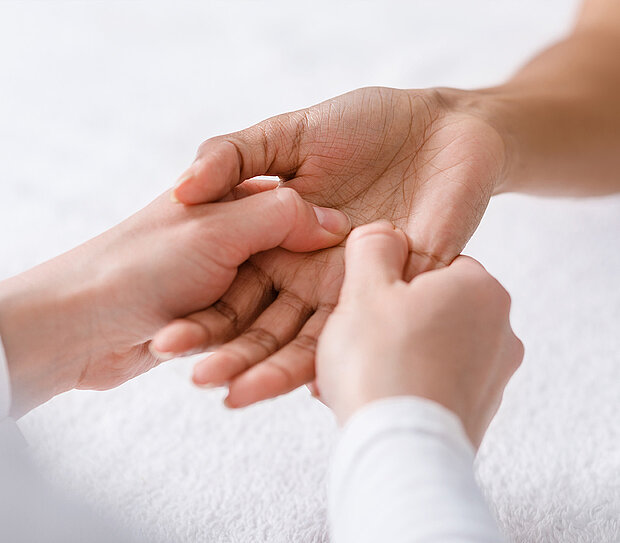
Acupuncture and acupressure are methods from traditional Chinese medicine. They involve stimulating certain points, such as on the wrist, to support physical balance. In acupuncture, fine needles are inserted into specific points on the body. In acupressure, the same points are stimulated using gentle pressure, e.g., with the fingers – without any needles. Acupressure can often be performed by the patient themselves, while acupuncture should be carried out by a professional. Some patients report relief, although the scientific evidence is limited and inconclusive.
Did you know?
For morning sickness, the P6 point on the inner wrist is often used: it is located about three finger widths below the palm, in the middle between two tendons. Gentle pressure on this point can relieve nausea in some women.
Relaxation & rest
Stress and excessive demands can exacerbate symptoms. Targeted rest periods, breathing exercises, or small relaxation rituals in everyday life can help calm the body. Many people find that consciously slowing down has a beneficial effect.
Does homeopathy help?
Homeopathy is sometimes recommended for morning sickness, but there is no proven medical effect. Scientific studies show that homeopathic remedies have no effect beyond the placebo effect. For more severe or prolonged symptoms, effective medical treatment options should therefore not be neglected and medical advice should be sought.

This article has been written in accordance with scientific standards and has been thoroughly checked for accuracy by ITF Pharma GmbH.
Published on 26.02.2026
Sources
- Babbar, Shilpa, and J. A. Y. E. Shyken. "Yoga in pregnancy." Clinical obstetrics and gynecology 59.3 (2016): 600-612.
- Campbell, Kim, et al. "The management of nausea and vomiting of pregnancy." Journal of Obstetrics and Gynaecology Canada 38.12 (2016): 1127-1137.
- O'Brien, Beverley, and Sarah Naber. "Nausea and vomiting during pregnancy: effects on the quality of women's lives." Birth 19.3 (1992): 138-143.
- Schmacke, N. Homöopathie: Heilslehre „ohne Substanz“. Bundesgesundheitsbl 63, 541–547 (2020). https://doi.org/10.1007/s00103-020-03125-8
Tips for treatment