
Staying active despite nausea
Gentle exercise can also be beneficial for morning sickness. Appropriate activity promotes well-being without overtaxing you or creating additional pressure.
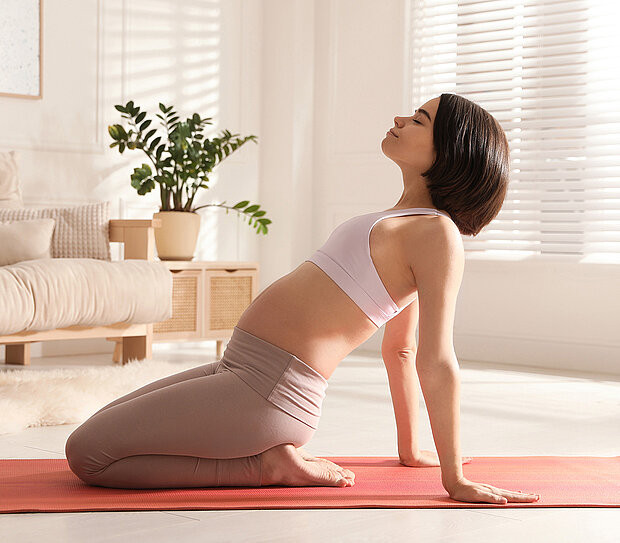
Gentle exercise in everyday life
Light exercise can help stabilize circulation, reduce stress, and improve overall well-being. Short walks, gentle stretching, or a few steps in the fresh air are often enough. It is important to adapt the activity to how you feel on the day and to consciously plan breaks. Exercise should relieve stress – not cause additional strain.
Did you know?
It is not the duration of the exercise that is important, but rather adapting it to how you feel on the day. Even short walks or light stretching are considered effective.
Breathing exercises and walking
Simple breathing exercises and light exercise in everyday life can also help with morning sickness. Calm, conscious breathing – for example, with prolonged exhalation phases – can help calm the autonomic nervous system and reduce stress. Short walks in the fresh air promote blood circulation, stabilize the circulatory system, and often have a balancing effect on the body and mind. It is not the duration that is important, but the regularity and adaptation to your own daily form. Even a few minutes can be enough to improve your well-being.
Yoga during pregnancy
Pregnancy yoga combines gentle movement with breathing exercises and relaxation. Slow, calm sequences can help release tension and strengthen body awareness. Especially in cases of nausea, the focus is not on physical performance, but on mindfulness and breathing rhythm. It is important to only perform exercises that are specifically suitable for pregnant women – no strong backbends, twists, or inverted poses.
If you experience dizziness, severe nausea, or discomfort, take a break or stop and pay attention to your body's warning signals.
These exercises help a lot of people
Upright sitting posture (e.g., cross-legged with raised pelvis): An upright, stable sitting position supports calm breathing and can help relieve pressure on the stomach. Many women find this posture centering and calming.
Cat–cow at a calm pace: Gentle movements of the spine in a quadrupedal position promote blood circulation, release tension, and can improve overall body awareness. It is important to maintain a slow, flowing rhythm.
Side stretches while sitting: Gentle side stretches open up the chest, make breathing easier, and can create a feeling of space without putting strain on the abdomen.
Child's pose in an adapted form: With knees wide apart and upper body upright or supported by pillows, this position can be perceived as relaxing and safe.
Breathing focus in supine or side position: Calm, conscious breathing – ideally with prolonged exhalation – can help reduce inner restlessness and subjectively alleviate nausea.
Respect your own limits
Being active does not mean sticking to a fixed schedule. On some days, rest is the most sensible form of self-care. Consciously recognizing your own resilience and allowing yourself breaks contributes significantly to maintaining physical and mental balance.

This article has been written in accordance with scientific standards and has been thoroughly checked for accuracy by ITF Pharma GmbH.
Published on 26.02.2026
Sources
- Orla Cunningham, Dr. Vivienne Brady, Women's views and experiences of pregnancy yoga. A qualitative evidence synthesis, Midwifery Volume 127, 2023, 103857 https://doi.org/10.1016/j.midw.2023.103857.
- Susette A. Moyers, Martin S. Hagger, Physical activity and cortisol regulation: A meta-analysis, Biological Psychology, Volume 179, 2023, 108548, ISSN 0301-0511, https://doi.org/10.1016/j.biopsycho.2023.108548.
- Buckwalter, J. Galen, and Stephen W. Simpson. "Psychological factors in the etiology and treatment of severe nausea and vomiting in pregnancy." American journal of obstetrics and gynecology 186.5 (2002): S210-S214.